


Money that keeps moving when the internet stops.

Wayamesh is a digital dollar wallet that works offline. Pay anyone face to face with a scan or over Bluetooth, and the payment settles the moment any phone reconnects.

  • You hold your keys
  • Works with no signal
  • Dollar-denominated (USDC)
Payment receivedBacked
+25.00 USDC

Built on

CircleArcArcUSDC
The problem

Every digital payment assumes a connection. Billions don’t have one.

Mobile money, cards and crypto all stop the moment the network does. This is not hypothetical. It has happened in the last few years, to people who had money and no way to spend it.

SudanFebruary 2024A blackout cut off the app that feeds a city

A near-total communications blackout began in early February 2024. Volunteers running Khartoum’s emergency kitchens, which feed hundreds of thousands of people, said they could not reach their mobile banking apps, and Islamic Relief said bank transfers, electronic payments and aid distributions were disrupted. A Khartoum resident told Reuters there was no cash and people could not log in to Bankak.

Sources: Amnesty International, The New Humanitarian, Reuters, 2024
MyanmarMarch 2021Mobile money almost stopped overnight

When mobile internet was cut on 15 March 2021, mobile money transfers were almost entirely suspended, and malls and supermarkets could not take card payments. Wave Money’s monthly active users fell from over 2 million in January 2021 to 1 million by the end of May.

Sources: KrASIA, South China Morning Post, 2021
Iran2026A national blackout that cost the economy billions

Iran’s national internet blackout in 2026 became the longest on record. NetBlocks estimated it cost the economy more than $1.8 billion in its first 48 days, and Iran’s business chambers warned that 300,000 to 500,000 people working in small online businesses faced ruin.

Sources: NetBlocks, bne IntelliNews, 2026
Tigray, Ethiopia2020 to 2022, and again in 2026Banks closed, the network cut, savings out of reach

During the Tigray war, aid workers said bank closures left millions of people unable to reach their savings to buy food, and Access Now called the communications blackout the world’s longest uninterrupted shutdown. In September 2026, with fighting renewed and phones and internet disrupted again, Reuters reported residents rushing to withdraw cash.

Sources: Access Now, Reuters, aid-agency reports
VenezuelaMarch 2019The lights went out, and so did every card terminal

A nationwide blackout began on 7 March 2019 and left much of the country without power for days. Without electricity and connectivity, card terminals and ATMs stopped working, and reporters described shops unable to take card payments and people struggling to buy food and water with the cash they could find.

Sources: Reuters, BBC News, AP, 2019
KenyaJune 2024Even in Kenya, the M-PESA app went down

On 25 June 2024, connectivity fell by nearly 40% across more than 20 Kenyan networks, according to IODA and Cloudflare. Safaricom told customers the M-PESA app was disrupted and to use the *334# menu instead, and blamed two undersea cables. The Internet Society said it could not verify the cause. The point stands either way: a payment method that needs a working network stops when the network does.

Sources: IODA, Cloudflare, Safaricom customer notice, Internet Society
A city skyline at dusk with lit office towers
1.4B
adults worldwide have no bank account
World Bank Global Findex, 2021
2.6B
people are still offline
ITU Facts and Figures, 2024
296
internet shutdowns in 54 countries in one year
Access Now #KeepItOn, 2024
Get Wayamesh

Start paying offline in two minutes.

Create a wallet, add test dollars, and try your first offline payment. Free during the beta.

Beta runs on Arc Testnet with test USDC. Get free test dollars at faucet.circle.com.

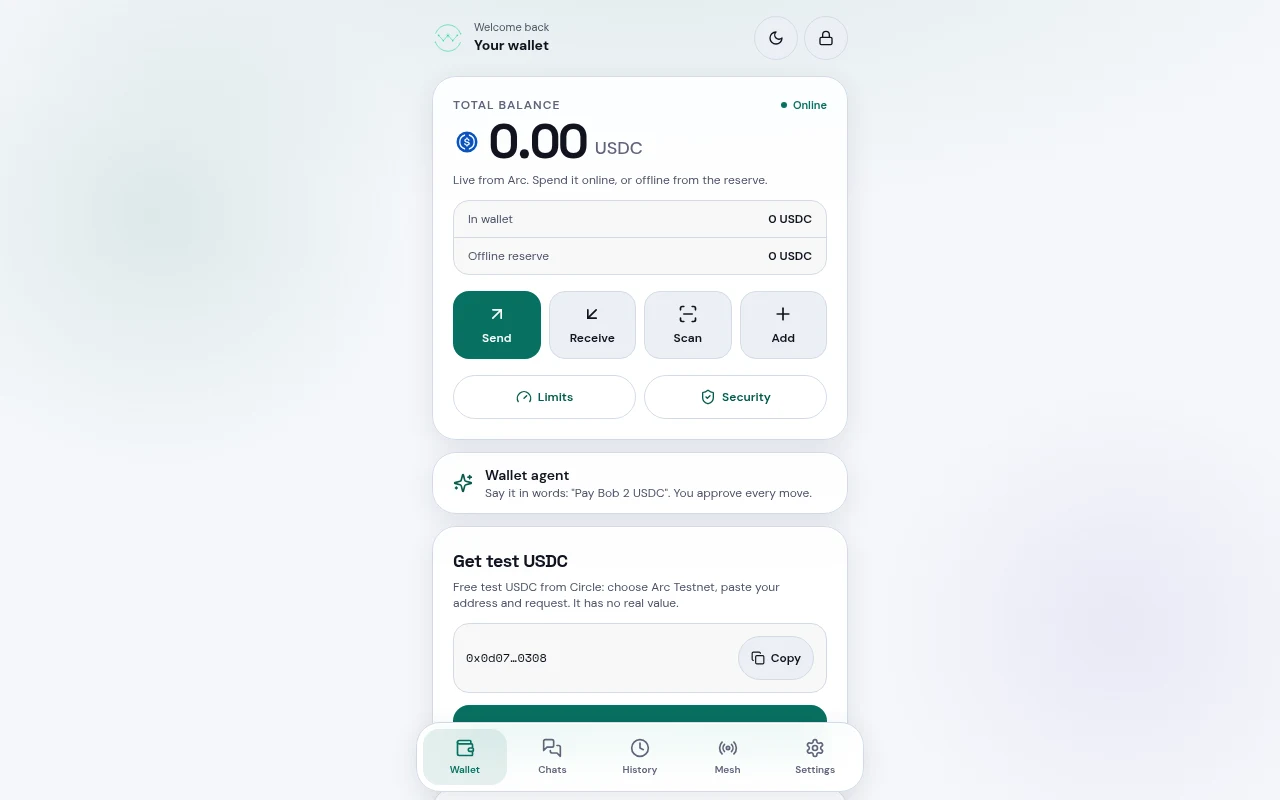
The Wayamesh web wallet home screen
How it works

Three steps. No signal required.

  1. 01

    Top up once

    Add USDC from M-Pesa or any wallet. Part of it becomes your offline reserve.

  2. 02

    Pay face to face

    No signal needed. Your phone signs the payment and they scan it.

  3. 03

    It settles by itself

    Whoever is online first settles it on Arc, usually in about a second.

Until it settles, an offline payment is a promise backed by the sender’s reserve.

Two-minute demo on Arc Testnet with test USDC. Not real money.

Who it’s for

Built for the places payments forgot.

We know who this is for: people who already pay with a phone, in places where the network cannot be trusted.

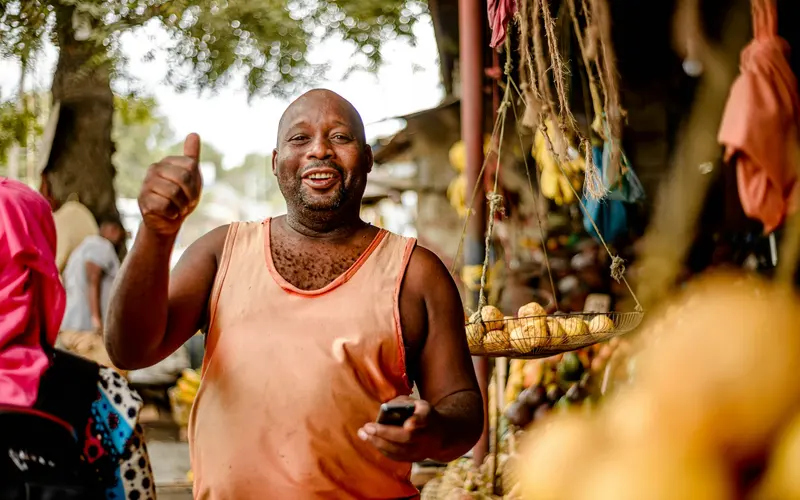
A smiling fruit seller holding a phone and giving a thumbs up at his market stall
Traders and kiosks in East Africa

Mobile money is how they pay. It still needs a signal.

In Kenya and across East Africa, market traders, kiosk owners and riders already take payment by phone. A stall can take a dollar payment by scan with no network at all, and it settles when any phone reconnects.

A family of five sitting together on stone steps outdoors at sunset
Families with relatives abroad

Money sent home that is ready to spend

People in the diaspora, from Kenya to Sudan to Ethiopia, send USDC to family where banks and networks are unreliable. The family holds digital dollars they can spend face to face, even when the line drops.

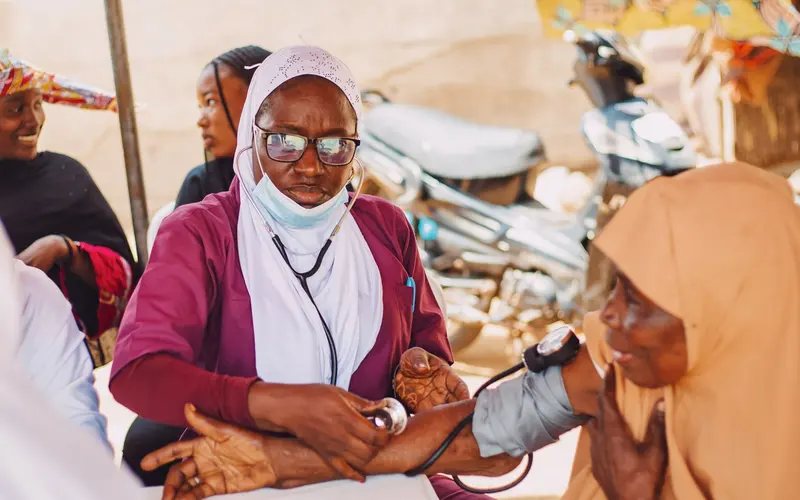
A community health worker checking a patient’s blood pressure at an outdoor clinic
Local relief groups

Cash that keeps working when the network is cut

Groups like Sudan’s emergency response rooms run emergency kitchens on mobile banking, and lost access when the network went down. Funds that can be paid offline, with every settled payment visible on-chain, keep them running.

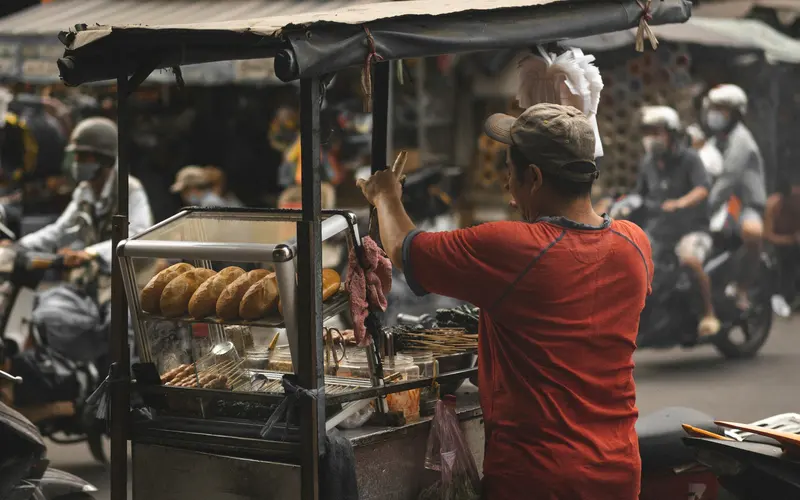
A street food vendor serving customers at his cart on a busy market street
People under shutdowns

Money in your wallet that you can still use

When a government or a war cuts the internet, as in Iran, Myanmar and Sudan, people can still pay each other face to face. Payments are held safely and settle when anyone gets a connection.

“Your money should work even when the internet doesn’t.”

Why we’re building Wayamesh

A smiling street vendor holding a tray of bread rings on a city sidewalk
Security

Built against how wallets actually get hacked.

Phished seed phrases, drained approvals, collapsed custodians, hidden admin keys. Here is what we do about each.

Phished seed phrase

Your 12 words never leave your phone. No account, no login, and we never ask for them. A PIN, and a delay after wrong tries, guard the wallet.

Drained by a bad approval

Each payment is its own signed voucher: one person, one amount, used once. No standing permission exists to pull more.

Custodian collapse

Nobody holds your money. Your reserve sits in a contract only you can take it back from. We have no balances to breach.

Hidden admin key

No owner, no pause, no upgrade switch. Nobody, including us, can freeze the contract or move your money.

Faked or reused payments

Altered, replayed and expired payments are rejected. The amount you see comes from the signature, not from what a sender typed.

Lost or compromised phone

Only what you put in the offline reserve is spendable offline. Keep it small, like cash in a pocket; the rest stays in your wallet.

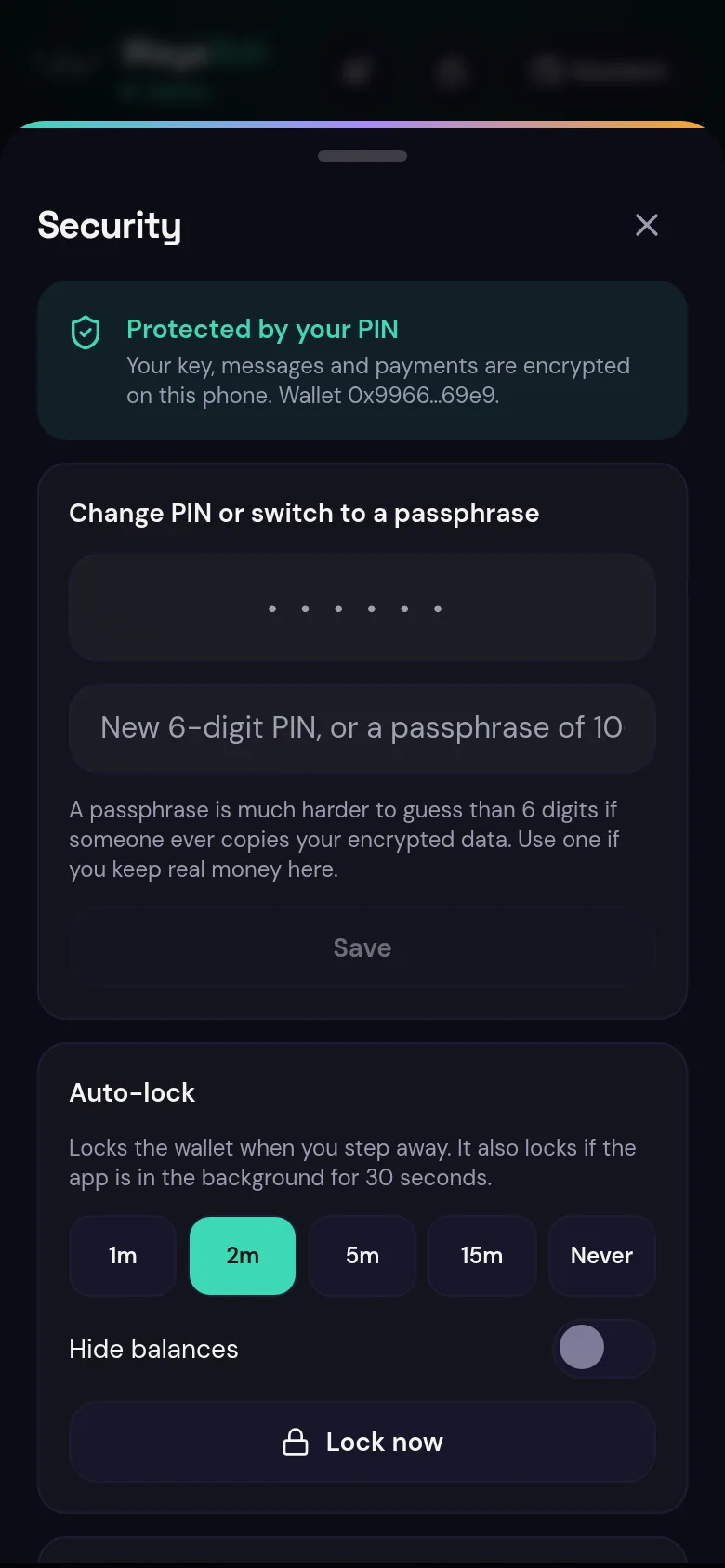
The Wayamesh Security screen: protected by your PIN, change PIN or switch to a passphrase, auto-lock
Roadmap

Working today. A clear path to real money.

The product is live on testnet. The next steps are the ones that earn trust: an audit, a real pilot, and a licensed cash-in and cash-out partner.

NowLive on testnet

The product works

Pay with no signal, settle when any phone reconnects.

  • Smart contract live on Arc, source verified, no admin key
  • Android app and web wallet
  • Free settlement: anyone can settle, even with no USDC
  • Group chats with payouts, no spending caps
Next0 to 3 months

Audit and pilot

Prove it with real people before real money.

  • Independent security audit and public bug bounty
  • Pilot with traders and kiosks in Kenya
  • Real-device testing: Android, Bluetooth, iPhone
  • Licensed payments partner signed for M-Pesa
Then3 to 9 months

Real money

Launch on Arc mainnet to a first market.

  • Arc mainnet launch after a clean audit
  • M-Pesa add money and cash out, live
  • Google Play and App Store apps
  • Local-language support and agent onboarding
Scale9 to 18 months

Every network, every border

Reach the people payments forgot.

  • Merchant tools and business accounts
  • Partner API for NGOs and mobile money operators
  • More East African corridors, then beyond
  • Multi-hop Bluetooth mesh

What funding unlocks

  • SecurityIndependent audit and bug bounty
  • MarketKenya pilot with traders and kiosks
  • ComplianceA licensed partner for cash in and out
  • ReachiPhone, Google Play and local support
Colleagues talking around a table in a bright meeting room
Partner with us

Bringing offline payments to your network?

We’re working with NGOs, mobile money operators, merchants and investors who want dollar payments to reach everyone, connected or not.

FAQ

Questions, answered.

Something else? Email us.

How can I pay with no internet?

Before you go offline, you move some USDC into a reserve held on the blockchain. Offline, your phone signs a payment against that reserve and shows it as a QR code, or sends it over Bluetooth. The other person receives it, and whichever phone gets a connection first settles it. QR and Bluetooth only carry a small signed message, like a signed cheque: it holds no money and contains no code. The smart contract is a separate program on Arc that holds the reserves and pays out when the message is submitted.

Can an offline payment be faked, copied, or can the payer cheat?

It cannot be faked or changed: a payment only works with the payer’s signature, and the signature covers every detail (who, how much, the tip, a one-time number and the deadline). It cannot be copied: each payment number works once, so scanning the same code a thousand times pays once. Once it settles it is final, because the contract has no owner or admin and no way to undo a payment. The honest limit: until it settles it is still a promise. A cheating payer could try to spend the same reserve twice, and whoever settles first wins. That is why the money is locked in the reserve and every payment expires within 24 hours. You can check a payment is funded as soon as you have any connection, so settle as soon as you can.

Who settles a payment, and what does it cost?

Any phone that is online can settle a payment: the payer, the person being paid, or a stranger who carried it. The first one to submit it wins and keeps the small courier tip (0.01 USDC by default). Settling costs a fraction of a cent in network fees (about 0.003 USDC in our tests), so the tip more than covers it. Wayamesh also runs an optional free settlement service: tap Settle for free and it settles the payment for a wallet that has no USDC. Nothing depends on it, because anyone can always settle. Wayamesh takes no cut.

Who holds my money?

You do. Your keys are created and kept on your device, and Wayamesh cannot move or freeze your funds. That also means we cannot recover a lost wallet, so write down your recovery phrase and keep it safe. Reserves live in one settlement contract, MeshPayV2 on Arc, alongside Circle’s USDC. It lets you withdraw after a delay, and it has no owner, no admin key and no upgrade path. Its source is verified on the Arc explorer. It has not had an independent security audit yet.

Can I add to my offline balance when I have no signal?

Not at that moment. Moving money into your offline reserve is a blockchain transaction, so it needs a connection, and the money has to be in the reserve before you go offline. To make that easy, the web wallet has an Auto top-up setting: choose an amount and it keeps your reserve filled whenever you are online and your wallet is open, so you are ready when the signal drops. Money in the reserve takes a day to take back out, so choose an amount you are happy to spend offline.

Is it live, and where does it work?

It is a testnet beta using free test USDC, so no real money moves yet. Mainnet launch follows an independent security audit. It works on the Android beta and on the web wallet, which runs in any modern browser with nothing to install. iPhone is coming. QR payments work between any two devices; Bluetooth hand-off is Android-only and still in beta.